


Confidently Conduct Clinical Trials with QPS Full Service Early Phase CRO Expertise
Moving quickly and safely through early-phase clinical trials is essential to successful drug development. As a global, full service CRO, QPS brings clinical execution, participant recruitment, and laboratory expertise together around your protocol, supporting your program from first-in-human studies through proof of concept.
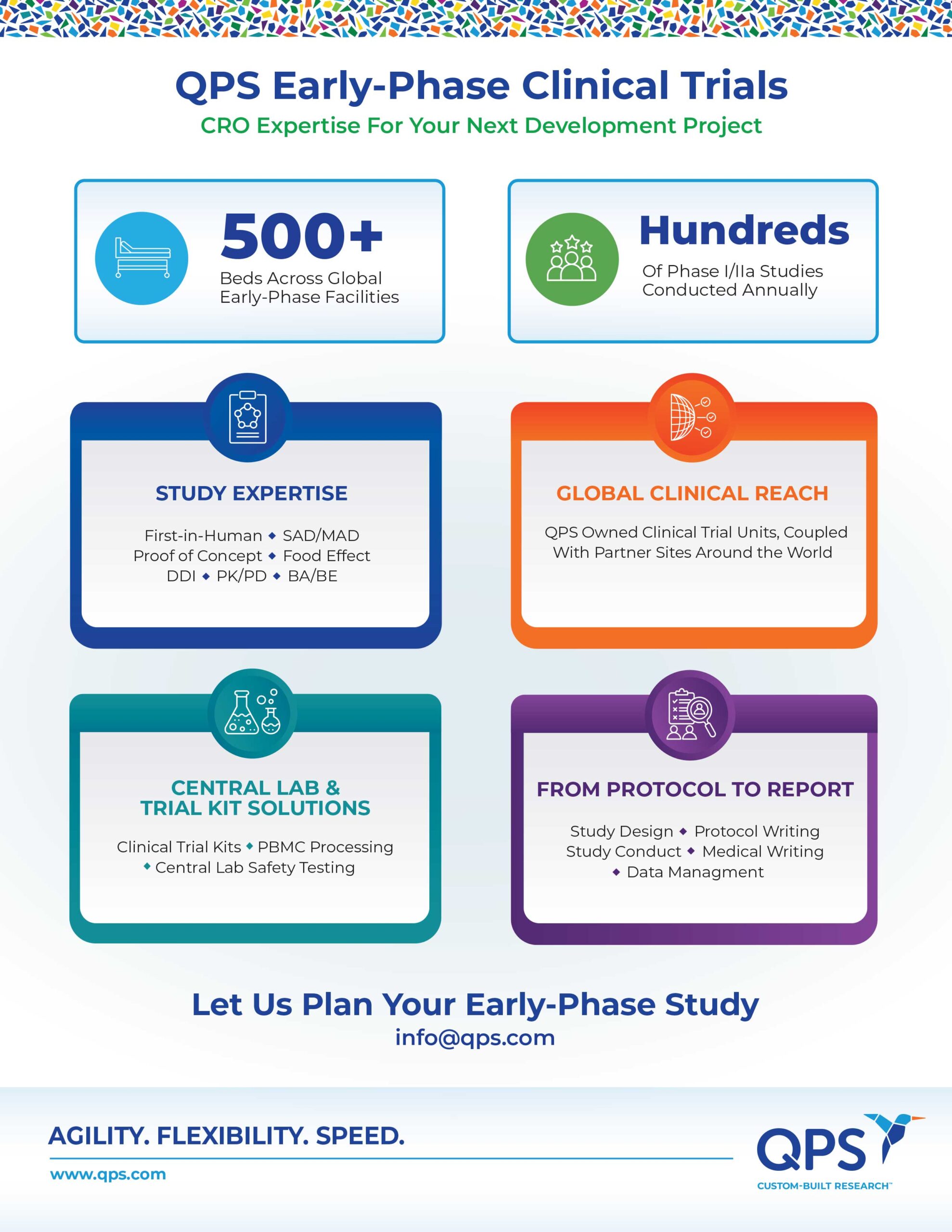
Our expert clinical pharmacology teams have a proven track record, conducting hundreds of Phase I and IIa studies annually. We excel in designing, managing, and interpreting early-phase studies with precision, ensuring reliable results and actionable insights.
Supporting this expertise, our global network of early- phase clinical research facilities offers more than 500 beds, providing access to diverse participant populations and the capacity to keep your study on track.

See Where your Study Can Take Shape
Global Reach and Expertise

QPS Miami: 110 Beds
Clinical research supported by participant recruitment, on-site sample processing, and pharmacy compounding capabilities.

QPS Missouri: 240 Beds
A dedicated clinical research campus with a separate screening and recruitment center.

QPS India: 138 Beds
Clinical research supported by 138 beds, participant recruitment, and on-site bioanalytical and laboratory services.

QPS Taiwan: 40+ Beds (in partnership with local hospitals)
Early-phase clinical research supported by bioanalysis, biomarker testing, pharmacology and toxicology expertise.
Considering another region?
Discuss QPS clinical capabilities and partner-site options in Asia, Europe, and Australia.
Discuss your location strategy.
Find the support your protocol needs
Proof-of-concept (POC) studies are a cornerstone of early-phase clinical development. These studies are designed to determine a drug’s safety and effectiveness, laying the groundwork for subsequent large-scale trials. At QPS, we conduct POC studies in a variety of study subject populations, providing critical data to guide your development strategy
Our well-designed POC studies:
- Minimize resource waste on targets or molecules unlikely to succeed.
- Provide clear, actionable insights into efficacy, tolerability, and safety.
- Establish a robust foundation for dose-response, efficacy, and safety assessments in later phases.
SAD and MAD clinical studies are types of dose-escalation studies conducted primarily in early-phase clinical trials, particularly in the context of Phase I studies.
- These studies are used to evaluate the safety, tolerability, pharmacokinetics (PK), and sometimes pharmacodynamics (PD) of a new drug or investigational product in healthy volunteers or, in certain cases, patient populations.
- The primary aim of both SAD and MAD studies is to determine the maximum tolerated dose (MTD) and inform dose selection for subsequent trials.
SAD and MAD studies are essential for assessing the safety, tolerability, and pharmacokinetics of a new drug or biologic.
- The primary goal of the SAD study is to determine the safety profile after a single dose and establish the maximum tolerated dose (MTD).
- The MAD study, on the other hand, focuses on assessing the safety and pharmacokinetics of repeated doses, providing data to determine the appropriate dosing regimen for future clinical trials.
|
Feature
|
Single Ascending Dose (SAD)
|
Multiple Ascending Dose (MAD)
|
|---|---|---|
|
Number of Doses
|
Participants receive a single dose of the investigational drug.
|
Participants receive multiple doses over several days/weeks.
|
|
Primary Focus
|
Safety and PK with a single dose.
|
Safety, tolerability, and PK/PD with repeated dosing.
|
|
Purpose
|
Assess how the drug behaves after a single dose.
|
Assess how the drug behaves after repeated dosing.
|
|
Study Duration
|
Typically shorter duration (several hours to a few days).
|
Longer duration (several days to weeks).
|
|
Key Endpoints
|
Maximum tolerated dose (MTD), pharmacokinetics after a single dose.
|
Cumulative effect, steady-state pharmacokinetics, long-term safety and tolerability.
|
|
Focus on Cumulative Effects
|
No (only single-dose effects are evaluated).
|
Yes (cumulative or long-term effects are monitored).
|
DDI studies are clinical studies conducted to evaluate the potential interactions between two or more drugs when taken together. These interactions can affect the pharmacokinetics (PK) or pharmacodynamics (PD) of one or more of the drugs involved, potentially leading to adverse effects, reduced efficacy, or unexpected drug behavior. DDI studies are crucial for understanding how drugs influence each other’s absorption, distribution, metabolism, excretion, and overall effectiveness.
The primary goal of a DDI study is to assess whether one drug affects the pharmacokinetics (PK) or pharmacodynamics (PD) of another drug when co-administered.
Key areas that are assessed include:
- Pharmacokinetics (PK) Interactions:
- Absorption: How one drug may affect the absorption rate or extent of another drug.
- Metabolism:The impact of one drug on the enzyme systems (especially cytochrome P450 enzymes) that metabolize the other drug.
- Excretion: Whether one drug alters the elimination or clearance of another drug from the body.
- Protein Binding: Some drugs may compete for binding sites on plasma proteins, leading to changes in the free (active) concentration of another drug.
- Pharmacodynamics (PD) Interactions:
- How drugs may alter each other’s pharmacological effects (e.g., additive or antagonistic effects).
- Safety and Efficacy:
- Identifying potential toxicities, adverse events (AEs), or altered therapeutic effects when drugs are used in combination.
DDI studies are essential for understanding how drugs interact when co-administered, influencing their safety, efficacy, and overall pharmacokinetic profiles. By evaluating both pharmacokinetic and pharmacodynamic interactions, these studies help inform drug dosing strategies, minimize the risks of adverse effects, and improve therapeutic outcomes. DDI studies are an integral part of early-phase clinical trials, guiding regulatory approval processes and safe clinical practice.
Food Effect studies are clinical trials designed to evaluate how food intake influences the pharmacokinetics (PK) of a drug. These studies are important because food can affect the absorption, distribution, metabolism, and excretion (ADME) of drugs, which may influence their efficacy and safety. Understanding food effects is crucial for determining the best way for patients to take a drug (e.g., with or without food) to ensure optimal therapeutic outcomes.
Several classes of drugs can have their pharmacokinetics significantly affected by food:
- Antiretrovirals (e.g., protease inhibitors like ritonavir): Often recommended to be taken with food to improve absorption.
- Antibiotics (e.g., doxycycline): Some antibiotics, like tetracyclines, are less effective when taken with dairy products due to binding to calcium.
- Statins (e.g., atorvastatin): Certain statins may be absorbed better when taken with food, but the effect can vary between different statins.
- Tyrosine Kinase Inhibitors (e.g., imatinib): These drugs can have altered absorption with food, affecting their efficacy.
Food Effect studies are crucial in drug development to understand how food impacts the absorption, distribution, and overall pharmacokinetics of oral medications. The results of these studies are used to inform labeling recommendations, ensuring that patients take medications in a way that optimizes their efficacy and minimizes potential side effects. These studies also help clinicians guide patients in the correct administration of drugs, considering potential interactions with food.
Purpose of PK/PD Studies:
- Pharmacokinetics (PK): Describes the absorption, distribution, metabolism, and elimination (ADME) of a drug in the body.
- Absorption: How the drug enters the bloodstream (e.g., oral, intravenous).
- Distribution: How the drug spreads throughout the body’s tissues and organs.
- Metabolism: How the drug is chemically altered by enzymes, often in the liver.
- Elimination: How the drug and its metabolites are excreted, typically through the kidneys or bile.
- Pharmacodynamics (PD): Describes the biochemical and physiological effects of the drug on the body, including the relationship between drug concentration and effect.
- Receptor Binding: How the drug interacts with its target receptor(s).
- Mechanism of Action: The biochemical pathway that leads to the drug’s effect.
- Effect on Organs/Tissues: How the drug causes changes at the organ or tissue level.
- Dose-Response Relationship: The relationship between the dose of the drug and the magnitude of the effect.
By combining PK and PD, researchers can:
- Determine the optimal dose that achieves the desired therapeutic effect with minimal toxicity.
- Understand the time course of drug effects (e.g., when to dose and how often).
- Identify factors that influence individual variability in drug response (e.g., age, genetics, disease status).
Bioavailability (BA) Studies
Bioavailability (BA) refers to the rate and extent to which the active ingredient of a drug reaches the systemic circulation and is available for therapeutic action at the site of action. The primary goal of a BA study is to assess how much of the drug reaches the bloodstream after administration and how quickly it does so.
Key Components of BA Studies:
- Absorption: The process by which the drug is taken up from the gastrointestinal tract into the bloodstream.
- Rate and Extent of Absorption: The key parameters for assessing bioavailability are:
- Cmax (Maximum Concentration): The peak plasma concentration of the drug.
- AUC (Area Under the Curve): The total drug exposure over time, which reflects the total amount of the drug that reaches systemic circulation.
- Half-Life (T1/2): The time it takes for the concentration of the drug in the plasma to reduce by half.
Purpose of BA Studies:
- To determine how much of the drug is absorbed and how fast, which impacts its therapeutic effectiveness.
- To help in formulating the most effective drug dosage forms (e.g., tablets, injections, etc.).
- To assess the potential influence of food, disease, age, or other factors on the drug's absorption.
Methods Used in BA Studies:
- BA studies typically involve the measurement of plasma drug concentrations after administering the drug. Blood samples are taken at various time points to plot concentration vs. time profiles.
- The study may be conducted under fasted or fed conditions, as food can significantly impact the drug’s absorption.
Bioequivalence (BE) Studies
BE studies compare the bioavailability of two different drug products, typically a generic version and the brand-name drug (reference product), to ensure they are therapeutically equivalent. Two drug products are considered bioequivalent if they deliver the same amount of the active ingredient to the bloodstream in the same amount of time under similar conditions.
Key Objectives of BE Studies:
- To demonstrate that the generic drug performs similarly to the brand-name product in terms of rate and extent of absorption, ensuring they have the same therapeutic effect and safety profile.
- To ensure that generic drugs can be substituted for the brand-name product without compromising therapeutic efficacy or safety.
Key Parameters for BE Studies:
The most commonly measured pharmacokinetic parameters to assess bioequivalence are:
- Cmax: The peak plasma concentration of the drug after administration.
- Tmax: The time at which the Cmax occurs.
- AUC (Area Under the Curve): The total exposure to the drug in the bloodstream over time, which reflects the total amount of drug absorbed.
The two drug products are considered bioequivalent if the 90% confidence intervals of the geometric mean ratio for Cmax and AUC fall within an acceptable range, typically 80% to 125%. This range ensures that any differences in absorption are not clinically significant.
Early Phase Clinical Trials FAQs
What early-phase clinical studies does QPS conduct?
How experienced are QPS’s clinical teams?
Where can QPS conduct my study?
What clinical capacity does QPS offer?
How can QPS support first-in-human trials?
Why conduct a proof-of-concept study?
What is the difference between SAD and MAD studies?
Can QPS provide laboratory support?
What additional study services are available?
Which therapeutic areas does QPS support?
Explore How QPS Approaches Complex Studies
Expedited Study Delivery
Explore the role of logistics in delivering an early phase study.
Pharmacy Support in Practice
Explore pharmacy considerations in expedited study delivery.
Integrated Services for Seamless Early-Phase Development
- First-in-Man Programs (SAD, MAD, FE, gender)
- Proof-of-Concept Studies
- Clinical PK/PD Studies
- BE/BA Studies
- Dose Response Studies
- Vaccine Studies
- Dermal and Transdermal Studies
- Drug-Drug Interaction Studies
- 505(b)(2) NDA Studies
- Human Mass Balance Studies
- Microdosing Studies
- Imaging (PET, fMRI) Studies
- Thorough QT/QTc Studies
Why Choose QPS for Early-Phase Clinical Trials?
- Global Presence: Access to diverse populations and regulatory environments.
- Extensive Experience: Hundreds of studies conducted annually across various therapeutic areas.
- End-to-End Integration: Seamless transition from early phase to late-stage development.
- Specialized Expertise: Dedicated facilities and teams for complex studies, including oncology and rare diseases.
- Commitment to Quality: Data you can trust, delivered on time and on budget.
Partner with QPS to accelerate your drug development journey and bring your innovations to life. Contact us today to learn how we can support your early-phase clinical trial needs.
Links to Relevant Documents
- Clinical Trials in Special Populations
- Early Phase Clinical Overview
- Expedited Study Delivery – Logistics
- Expedited Study Delivery – Pharmacy
- Studying Sedatives in Phase I Studies
- Pharmacokinetic Studies in Patients
- Selecting the Location of a Phase I Clinical Trial in the EU
- Corporate Overview Clinical Sites
Testimonials
I have been a monitor for many years and haven’t seen a site as good as QPS Miami. It looks amazing!
"A well-designed, well-executed and well-reported study, with a top-notch partner!"
VASSILIOS G. ASLANIS, Head of Clinical Pharmacology

Contact Us
Would you like to learn more about other QPS capabilities?
Visit: https://www.qps.com/
Set Up a Meeting: https://www.qps.com/contact
Email: info@qps.com