


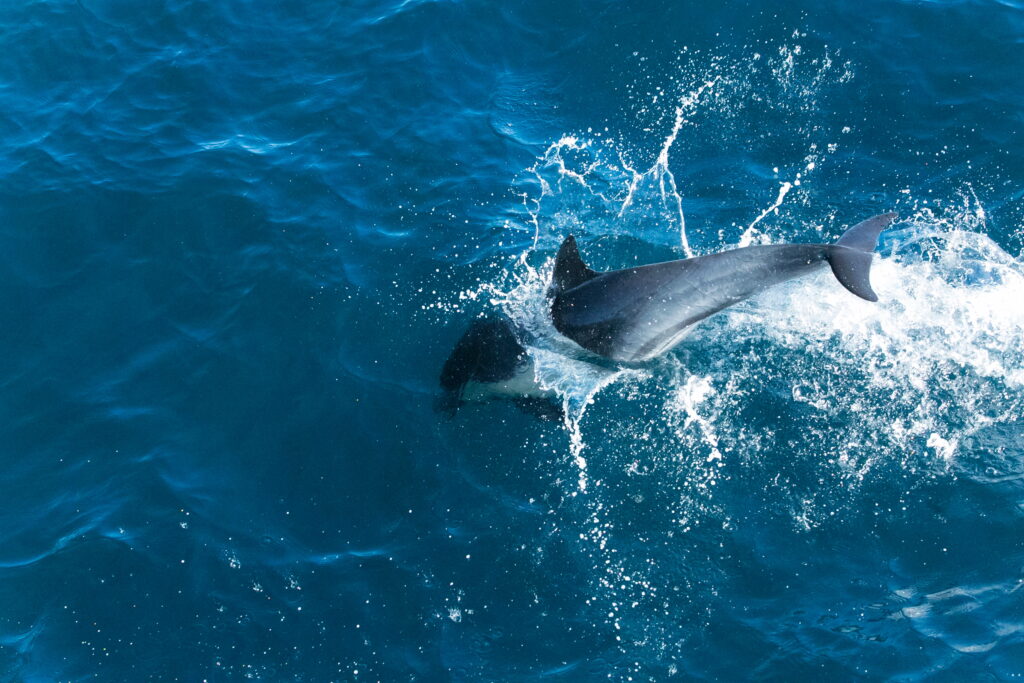
If popular media is to be believed, life under the sea involves dodging aggressive apex predators — vicious sharks, thrashing saltwater crocodiles, and territorial killer whales ready to destroy anything in their path. But a new study suggests that some predators may actually work with other animals to find food. Per the study, certain dolphins and orcas may exhibit unexpectedly cooperative behavior, helping each other in their pursuit of food. The animals may even share fish scraps.
We’ve shared more information about the study, published in Nature on December 11, 2025, below.
When Predators and Prey Find Common Ground
The study, led by oceanographer Dr. Sarah Fortune, took place in the frigid waters off British Columbia. The research focused on two types of marine mammals: playful Pacific white-sided dolphins and a population of fish-eating orcas often seen near the dolphins off the coast of the Pacific Northwest.
Dolphins and orcas have had a historically contentious relationship, as some transient orcas, known as Bigg’s killer whales, are known to hunt dolphins for food. But this study showed that orcas can behave amicably toward dolphins, and vice versa. Beyond that, the researchers witnessed what appeared to be “cooperative foraging” between the species.
Understanding Marine Mammal Behavior
Before Fortune’s team identified the animals’ cooperative foraging, they had several hypotheses as to why Pacific white-sided dolphins and orcas associate in the water:
- Kleptoparasitism: The researchers initially thought the dolphins were “stealing prey from the killer whales.”
- Protection: The team wrote that the dolphins could have been “seeking protection from mammal-eating transient (Bigg’s) killer whales.” These whales, as mentioned above, seek out dolphins as a food source, but are a different ecotype than the fish-eating northern resident killer whales observed in this study. The study also notes that dolphins could be associating with orcas “to learn acoustic signals… needed to evade predation” from mammal-eating killer whales.
But it was the final hypothesis — the possibility that dolphins and killer whales may be engaging in cooperative foraging for Chinook salmon — that proved most relevant. “Our data revealed behavioural patterns that were inconsistent with competitive, kleptoparasitic or anti-predator relationships,” the study reads, suggesting that the animals may instead have a “functional relationship potentially rooted in cooperation.”
Tracking Foraging Dolphins
To reach this conclusion, Fortune and her colleagues had to track the animals. They began by attaching suction-cup tags to fish-eating resident killer whales off Vancouver Island, British Columbia. Each tag was equipped with a camera and an acoustic recorder, allowing the team to capture underwater video and audio. The team also deployed several drones to film the animals from above.
As expected, the orcas trailed behind the dolphins. During these instances, the team documented a series of variables: which animals completed foraging hunts, any echolocation clicks emitted by the dolphins and the whales, any deep-diving behaviors, and whether dolphins were present when whales dined on salmon at the surface.
Overall, the team identified 25 occasions when orcas trailed dolphins during foraging hunts, following them on deep dives to catch salmon. Interestingly, the acoustic data revealed that both species alternated periods of echolocation during these dives. “We hypothesize that it could be that they’re eavesdropping on each other,” to locate food, Fortune told The New York Times. Finally, the study documents eight occasions during which orcas ate and shared Chinook salmon with other orcas. On four of these occasions, dolphins were present. On one occasion, the dolphins scavenged fish scraps after the orcas finished their meal. Ultimately, the researchers classified this behavior as cooperative foraging, “characterized by individuals working together to detect, pursue, and capture prey.”
_____
So, are dolphins and killer whales lunch buddies? Not exactly. However, studies like this one prove that animals inhabit complex ecosystems all their own. These dynamics may not be immediately clear to human observers; however, with future research, experts like Dr. Fortune could tap into even more of these surprising symbiotic relationships.
QPS is a global, full-service, GLP/GCP-compliant contract research organization (CRO) delivering the highest grade of discovery, bioanalysis, preclinical and clinical drug development services. Since 1995, QPS has grown from a small bioanalysis shop into a full-service CRO with 1,200+ employees in the US, Europe, Asia and India. Today, QPS offers expanded pharmaceutical contract R&D services with special expertise in pharmacology, DMPK, toxicology, bioanalysis, translational medicine, PBMC processing, central safety labs, clinical trials, and clinical research services. An award-winning leader focused on bioanalysis and clinical trials, QPS is known for proven quality standards, technical expertise, a flexible approach to research, client satisfaction, turnkey laboratories, Phase I/II clinical units, and multi-site clinical research services. Through continual enhancements in capacities and resources, QPS stands tall in its commitment to delivering superior quality, skilled performance, and trusted service to its valued customers. For more information, visit www.qps.com or email info@qps.com.