

Global Regulatory Affairs
QPS offers extensive Global Regulatory Affairs (GRA) services, which allow pharmaceutical, biotechnology, and medical device companies to develop custom-built research solutions in compliance with regulatory agencies worldwide. Our expertise encompasses discovery, preclinical, clinical, and commercial regulatory services to bring new technologies to patients faster.
Why You Need a Global Regulatory Affairs Partner
Experience is key when guiding drug development through the regulatory process. With that in mind, QPS offers a full suite of GRA services to drive innovative asset development, along with external and internal stakeholder engagement, driving our clients toward precise, groundbreaking research outcomes.
As a GRA team, we are known for our deep, global regulatory knowledge. Our team of professionals has deep expertise in the varied and nuanced rules and regulations tied to drug development programs around the world. At QPS, we offer partnerships to meet individual client needs throughout the development lifecycle, providing strong support and a range of capabilities to ensure your regulatory interactions, discussions, and documents are comprehensive and cohesive, driving toward the success of your product development initiatives.
Our custom-built global regulatory programs and solutions are designed to ensure your asset development and external stakeholder management are second to none.
The Importance of Regulatory Planning
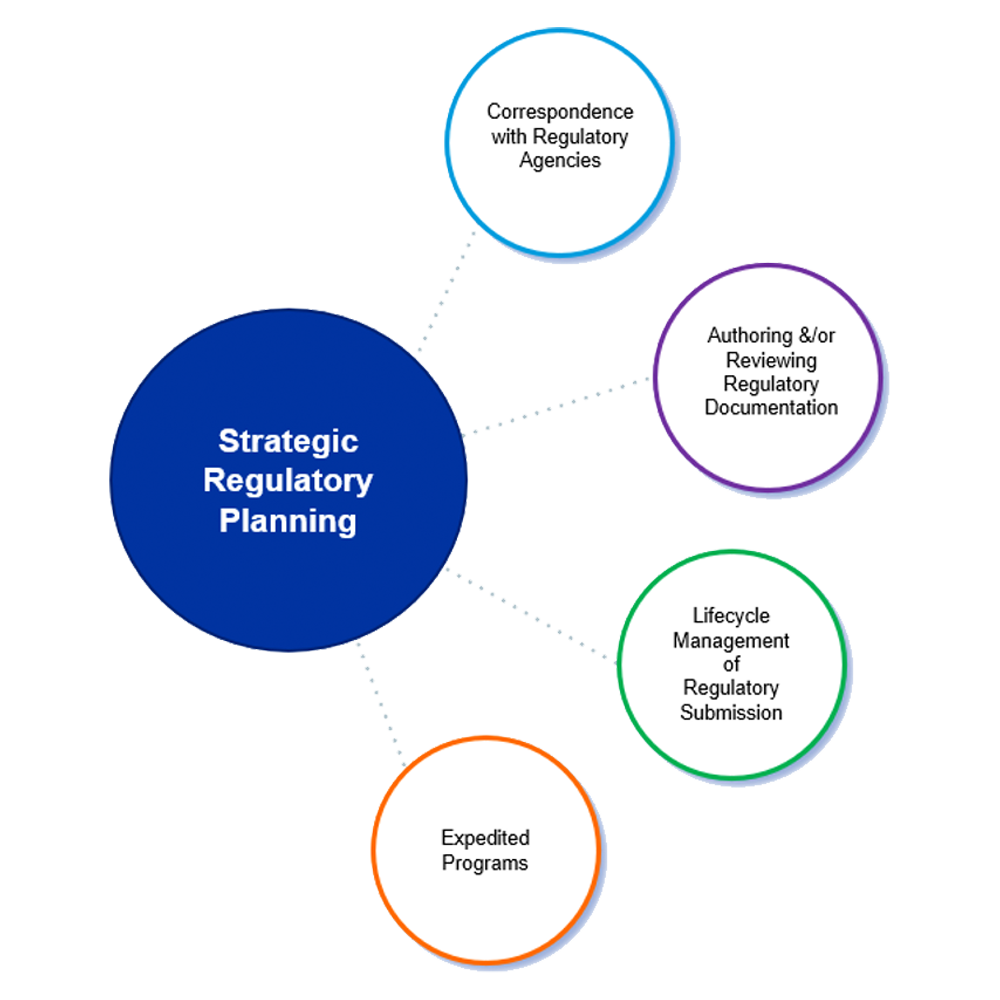
The Global Regulatory Affairs (GRA) framework encompasses the regulations set forth by regulatory bodies worldwide. The framework’s primary goal is to safeguard public health by overseeing the development, manufacturing, and distribution of medical testing products while ensuring compliance with applicable standards.
The Global Regulatory Affairs Process
Requests from Regulatory Agencies
Pre-submission Meetings
US FDA – Type A, B, C meetings I BPD meetings for biosimilars I pre-ANDA meetings for complex generics I EMA – scientific meetings I EMA pre-submission meetings I pre-CTA meetings I NMC meetings
Regulatory Feedback Meetings
Preparation of meeting minutes I Support in implementing action items post Health Authority engagement I Regulatory mitigation plans, if deficiencies have been identified
Regulatory Documentation Support
Global first-in-human applications I Ongoing safety reporting I Global marketing applications I Supplements and annual reports I eCTD documents (electronic publication and submission) I Inspectional Readiness Program
Regulatory Support Throughout Product Lifecycle
Annual reports I Supplements I Safety reporting I Import/export regulatory documentation I Rolling product review applications I Post-approval commitments planning and implementation I CMC lifecycle management I Annual registrations and listings I Regulatory assessment of supporting documents to support and plan for submission of renewal applications
Expedited Program Support
Orphan drug applications I INTERACT I Regenerative Medicine Advance Therapy (RMAT) I Breakthrough I Fast Track I PRIME I Sakigake
QPS Global Regulatory Affairs Planning Phases
QPS can work with you to navigate the complex Global Regulatory Affairs framework, ensuring your product’s compliance and efficiency en route to global market access. For support with your GRA needs, contact our experts today.
Strategic, Preclinical Regulatory Planning
- Expedited Programs such as INTERACT, Regenerative Medicine Advance Therapy (RMAT), Breakthrough, Fast Track, PRIME, and Sakigake
- Investigational New Drug (IND)
- Clinical Trial Application (CTA)
- Investigational Medicinal Product Dossier (IMPD)
- eCTD publishing
Late Phase (Phase IIb-IV) Clinical Regulatory Services
- Annual reports and supplements
- Periodic Benefit-Risk Evaluation Report (PBRER)
- Safety reporting
- Global Electronic Common Technical Document (eCTD) publishing
- Inspectional Readiness Program
- Accelerated approval
Early Phase (Phase I-IIa) Clinical Regulatory Services
- Rolling submission
- Accelerated programs
- Annual reports
- Supplements
- Safety reporting
- Regulatory briefing documents and communications
Post-approval/ and Commercial Phase Regulatory Services
- Annual reports and supplements
- Periodic Adverse Drug Experience Report (PADER), Periodic Adverse Experience Report (PAER), and Periodic Safety Update Report (PSUR)
- Pharmacovigilance
- Inspection findings commitments and responses
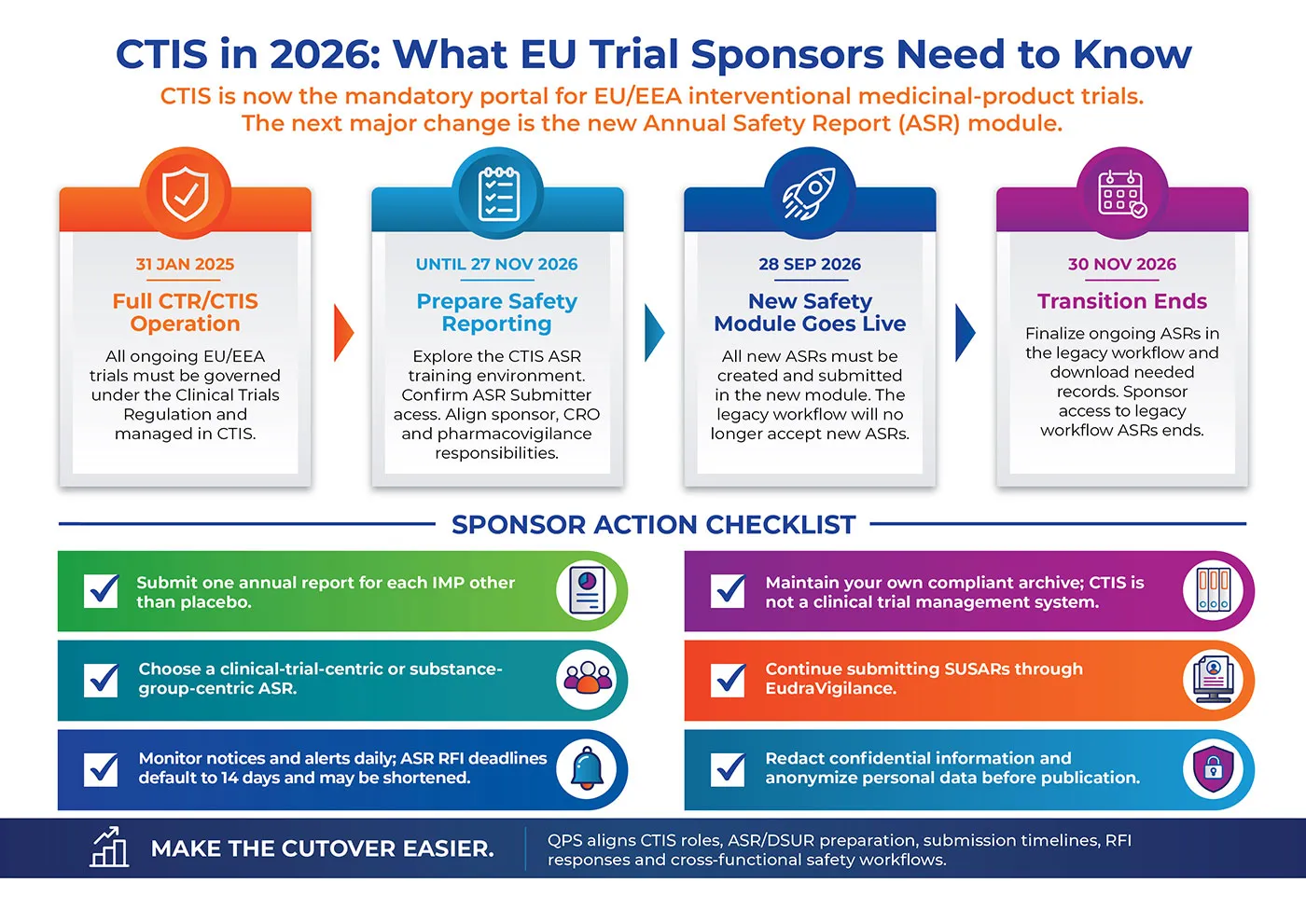
CTIS Annual Safety Reporting: Be Ready for September 28, 2026
The new CTIS Annual Safety Report (ASR) module changes how sponsors submit, manage, and respond to regulatory review of safety reports in the European Union.
QPS can help you prepare before the transition, bringing Regulatory Affairs, Clinical Operations, Medical Writing, and Pharmacovigilance together in one coordinated process. You gain clearly assigned responsibilities, submission-ready documentation, effective CTIS oversight, and faster responses when regulators request additional information.
Links to Relevant Documents
Beginning on September 28, 2026, every new ASR must be submitted and managed through the new CTIS safety module.
ASRs already underway before September 28, 2026, can be completed in the existing CTIS system through November 30, 2026. Before the transition period ends, sponsors should complete all pending activities and download any records they may need, as they will no longer have access to finalized ASRs in the existing system after that date. EMA transition announcement

Establish Clear Ownership
Avoid delays caused by unclear roles or handoffs by working with QPS to define who prepares, reviews, approves, and submits each ASR, and who monitors CTIS and coordinates the response to a Request for Information (RFI).

Connect Regulatory and Safety Workflows
Keep CTIS activities aligned with Development Safety Update Report (DSUR) preparation, EudraVigilance reporting, clinical operations, medical review, and broader pharmacovigilance processes. A coordinated workflow helps reduce gaps, duplication, and last-minute reconciliation.

Prepare for Regulatory Review
Member States may request additional information when reviewing an ASR. QPS helps establish escalation paths, review procedures, and response responsibilities so your team can act efficiently within the applicable CTIS timelines.
How QPS Supports CTIS Annual Safety Reporting

Assess Readiness
- Review your CTIS access, roles, reporting portfolio, SOPs, data flows, and upcoming submission dates.

Define Responsibilities
- Establish clear ownership across the sponsor, QPS, and other pharmacovigilance or regulatory partners.

Prepare and Submit
- Coordinate ASR/DSUR authoring, medical and regulatory review, publishing, approval, and CTIS submission.

Manage Regulatory Follow-Up
- Monitor the assessment, coordinate subject-matter experts, and prepare clear, consistent responses to RFIs.
CTIS Frequently Asked Questions
Which products require an ASR?
Sponsors generally submit one annual report for each investigational medicinal product used in a clinical trial. When a trial includes multiple investigational medicinal products, a combined report may be permitted, if the protocol allows it.
What does an ASR report include?
TBD
How long does reporting continue?
TBD
What happens after submission?
TBD