




Executive Summary
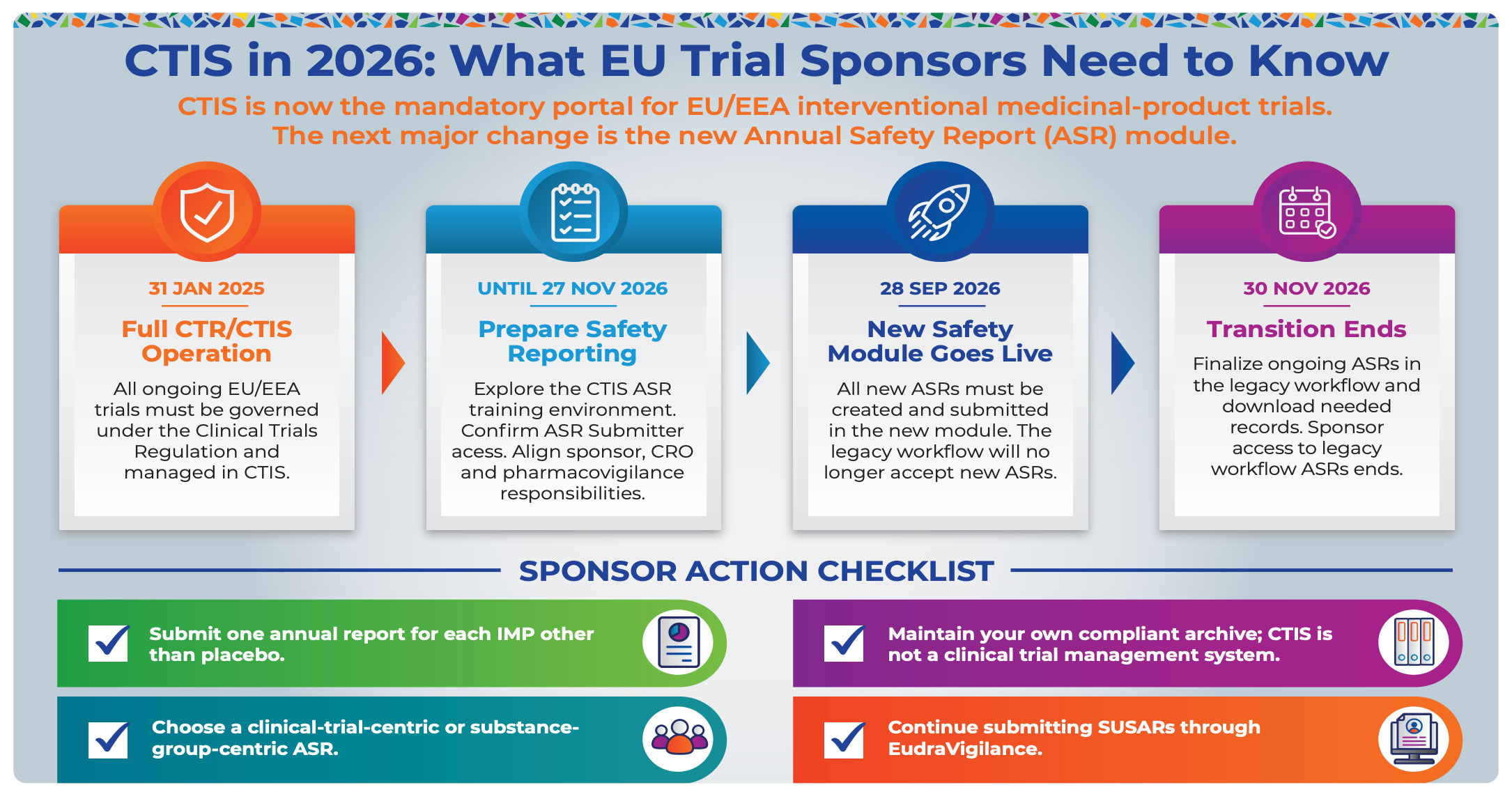
As of January 31, 2025, interventional clinical trials with medicinal products conducted in the European Union and European Economic Area are managed under the European Union Clinical Trials Regulation (EU) No. 536/2014. The regulation replaced the prior EU Clinical Trials Directive framework and established a harmonized approach to clinical trial applications, assessment, authorization, supervision and reporting across EU/EEA Member States. Its central operating platform is the Clinical Trial Information System (CTIS), the single-entry portal for clinical trial submissions, regulatory communications and public trial information.
CTIS management remains an active operational challenge for clinical trial sponsors. Sponsors now need to manage in-scope EU/EEA trials within a system that combines coordinated multinational assessment with country-specific requirements, strict response timelines, structured data entry, lifecycle notifications and public disclosure obligations.
CTIS can reduce duplicate submissions and support more coordinated European development. Those benefits depend on disciplined dossier planning, rapid responses to requests for information (RFIs), publication-ready information, role governance, safety-reporting readiness and lifecycle tracking outside CTIS. Missed deadlines, inconsistent documents or mishandled confidential information can delay authorization, cause an application to lapse or disclose information prematurely.
This white paper explains the current CTIS operating model, the submission and assessment process, revised transparency requirements, 2026 ASR Safety-module considerations and lifecycle controls that can help sponsors keep European clinical development programs moving.
How CTIS Changes Eu/Eea Trial Operations
One Submission Route
Sponsors can use one CTIS application to seek authorization in one or more EU/EEA Member States. A coordinated Part I assessment reduces duplicated regulatory work and helps sponsors build a more consistent regional strategy
Shared Regulatory View
The Reporting Member State coordinates Part I with the other Member States Concerned. A common dossier and visible timetable make dependencies easier to identify and manage.
Lifecycle Visibility
CTIS provides a common route for initial applications, additional Member States, substantial and non-substantial modifications, trial notifications, annual safety reports and results. Central oversight supports better portfolio planning.
Public Access
The public portal makes authorized trial information searchable for patients, investigators and researchers. For sponsors, well-prepared public content can support transparency while protecting personal data and commercially confidential information.
Navigating The CTIS Structure
CTIS is the required regulatory portal, database and secure archive for submissions, communications, decisions and public trial information. It includes a secure sponsor workspace, a secure authority workspace and a public website. It is not a clinical trial management system and does not replace the sponsor’s internal clinical trial management, document control or compliance systems. Sponsors must maintain their own compliant systems as the authoritative trial records.
Choose The Governance Model Early
Organization-centric governance gives a Sponsor Administrator control across trials and affiliates; trialcentric governance assigns administration per trial. Either model needs backups, appropriate separation of preparer and submitter roles and documented reviews.
Complete Prerequisites Before Dossier Entry
Sponsors need active European Medicines Agency (EMA) accounts, an Organization Management Service (OMS) record, EudraVigilance registration and Extended EudraVigilance Medicinal Product Dictionary (XEVMPD) records for investigational medicinal products. These steps can take many days. OMS registration alone may take up to 10 days. Completing them early protects the planned submission date.
Treat Source Data as Controlled Data
CTIS retrieves organization and product information from OMS and XEVMPD, but copied information does not update automatically when the source database changes. Sponsors must manage corrections through an RFI, substantial modification or non-substantial modification, depending on the affected field.
Build Part I For Regional Consistency
Part I covers trial design, protocol, investigational product, benefit-risk and other common scientific elements. Part II covers national and site-level requirements such as informed consent, recruitment, investigator and facility suitability, compensation and data-protection documentation. Country-specific language, fee and template requirements will require local expertise.
Plan Third-Party Product Access
When a sponsor is not the product owner and should not receive the quality Investigational Medicinal Product Dossier (IMPD), CTIS supports protected product-owner workflows. The sponsor and owner should agree on responsibilities, timing and RFI response procedures before submission, so confidential quality information does not become a schedule constraint.
Assessment Process And Time-Sensitive Execution
For an initial application, the standard evaluation timeline is 60 days, but RFIs and application-specific factors can extend the timetable. In a multinational trial, Reporting Member State selection occurs in parallel with validation. Part I is assessed collaboratively; each Member State assesses its own Part II and issues its decision.
Requests For Information
RFIs can be raised at any point during validation or assessment. The maximum sponsor response period is 10 days during validation and 12 days during assessment, but authorities may set shorter deadlines. If the response is late or incomplete, the application can lapse.
A practical response model includes daily CTIS monitoring, named subject-matter experts, pre-approved escalation routes, rapid translation capacity, controlled document versioning and an authorized submitter available before the EU deadline. Because CTIS email notices require optin and alerts disappear after 90 days, internal tracking is essential.
Sequence Modifications Deliberately
CTIS supports applications to add Member States, as well as substantial and non-substantial modifications. Sponsors need to sequence these submissions carefully because concurrent submissions are limited, and each draft reflects the last authorized application at the time it is created. Later changes are not added retrospectively, so drafts created too early may carry forward superseded content.
Sponsors should maintain a trial-level submission roadmap showing the scope, country impact, document dependencies and allowable sequence of each application. This is especially important when an updated investigator brochure, IMPD or reference safety information affects several trials.
Part I-Only Submissions
Part I and Part II may be submitted together or, where permitted, sequentially. If an initial application is limited to Part I, Part II must generally be submitted within two years of the Part I conclusion. Sponsors should confirm the latest Member State and Clinical Trials Coordination Group (CTCG) guidance before using a staggered approach.
Control The Clock Before the Clock Controls The Study
High-quality dossiers and a rehearsed RFI process reduce avoidable review cycles. They also protect scarce internal experts from last-minute document reconstruction, helping the program reach country decisions and site activation with fewer preventable interruptions.
Revised CTIS Transparency Rules
Since June 18, 2024, sponsors have operated under revised CTIS transparency rules. The rules eliminated the former deferral mechanism, narrowed the set of published documents and may lead to earlier publication of certain key trial information. Publication timing depends on trial category, participant age group and, for certain integrated Phase I/II studies, trial phase.
Publication Is Part of Dossier Design
Sponsors must review the publication status of every structured field and document before submission. Structured fields cannot be redacted. Public fields should contain no personal data or commercially confidential information, and functional contact details should be used instead of personal contact details.
For publishable documents, the first uploaded version must exclude protected personal data and commercially confidential information. A fuller regulatory version is linked as not for publication. Upload order is therefore a material control.
What is Generally Published?
For Category 2 and 3 trials, key data and documents are generally published at the first Member State decision. Category 1 rules differ; some adult-only Phase I information is published later, while pediatric and Pediatric Investigation Plan-related rules have separate timing.
Applications submitted before June 18, 2024, are treated as historical trials. Their original documents were not automatically published when the revised rules took effect, but documents submitted with later modifications may become public under current rules.
Reduce Disclosure Risk Without Slowing Submission
Create public-facing versions with the core dossier, apply standard redaction criteria, remove metadata, and perform a separate publication review. This keeps regulatory and disclosure workstreams moving together.
CTIS Responsibilities Continue After Authorization
Trial Status and Safety Notifications
Sponsors must keep CTIS current after authorization. Unexpected events affecting benefit-risk must be reported without undue delay and within 15 days. Urgent safety measures and serious breaches must be reported within 7 days. Suspected Unexpected Serious Adverse Reactions (SUSARs) reporting continues through EudraVigilance.
September 28, 2026: The New ASR Module Becomes Mandatory
On Monday, September 28, 2026, every new Annual Safety Report (ASR) must use the new CTIS Safety module; the current functionality will stop accepting new reports. Before go-live, sponsors should complete training, appoint a Sponsor Safety Administrator, assign correctly scoped ASR Submitter roles, and select the clinical-trial-centric or substance-group-centric route. Sponsor Administrator or CT Administrator access alone does not provide Safetymodule business permissions. Early testing protects timelines and avoids access failures.
Two-Month Transition Period
ASRs already in progress on September 28, 2026 remain in the current functionality, including RFI responses, through the two-month transition period, expected to end in late November 2026; they will not migrate. Before access closes, sponsors should download any unarchived submission data, relevant RFIs and responses and final assessment records. A portfolio inventory showing owner, status, next action and download confirmation reduces handoff, inspection and continuity risk.
Q4 2026 and Q1 2027 Deadline Control
As of August 2026, the EMA has not announced another major CTIS system change for Q1 2027. However, sponsors should map trial-specific ASR dates, RFI windows, 7- and 15-day safety and notification clocks and 6- or 12-month results deadlines across year-end staffing. Planned coverage helps prevent a holiday resource gap from becoming a compliance issue.
End of Trial and Results
After a trial ends or is terminated early, sponsors must notify CTIS within 15 days. They must also submit a technical summary of results and a layperson summary within one year after the trial ends in all EU/EEA Member States, or within six months for pediatric trials and trials included in a Pediatric Investigation Plan. These obligations apply regardless of trial outcome.
Three Controls That Protect the Program
- Portfolio governance. Maintain central ownership of CTIS roles, application sequencing, deadlines and document standards across every EU trial
- Submission readiness. Reconcile OMS and XEVMPD data, country requirements, public versions, translations and signatures before the planned submission date
- Lifecycle surveillance. Monitor notices, RFIs, modifications, safety obligations, trial-status notifications and results deadlines through a controlled tracker outside CTIS
Together, these controls help sponsors obtain the harmonization benefits of CTIS while reducing avoidable delay, compliance exposure and internal workload.
Qps Solutions And Services
QPS helps clinical trial sponsors translate EU CTR requirements into an executable clinical development plan. Our regulatory and clinical teams can support a single submission or provide coordinated management across the trial lifecycle, including:
- EU regulatory strategy, country planning and Reporting Member State considerations
- CTIS account readiness, role governance, standard operating procedures and training
- Initial applications, additional Member States, substantial and non-substantial modifications, RFIs and trial notifications
- Part I/Part II dossier coordination, country requirements, document quality control, translations and publication-ready versions
- ASR transition readiness, safety-module roles, legacyrecord downloads, annual safety reports, results and lay summaries, with timeline oversight through study closeout
For sponsors, the benefit is continuity. QPS connects regulatory strategy with clinical operations, helping teams prepare CTIS submissions, manage country-specific requirements, respond to RFIs, maintain publication-ready documents and track obligations after authorization. That support can reduce handoff risk, protect critical deadlines and keep European development programs aligned as studies change.
Keep Your European Clinical Program Moving
CTIS rewards preparation, disciplined execution and fast cross-functional coordination. QPS can help your team build a submission strategy, manage CTIS obligations and maintain lifecycle oversight after authorization — so your internal resources can stay focused on the science and the next development decision.
REFERENCES
- European Medicines Agency. Clinical Trials Regulation becomes fully applicable. 31 January 2025. Accessed 10 September 2026. https://www.ema. europa.eu/en/news/clinical-trials-regulation-becomes-fully-applicable
- European Medicines Agency. CTIS Sponsor Handbook, Version 6.4. 7 July 2026. Accessed 10 September 2026. https://www.ema.europa.eu/en/documents/ other/clinical-trial-information-system-ctis-sponsor-handbook_en.pdf
- European Commission. Clinical Trials Regulation Questions & Answers, Version 7.2. 27 March 2026. Accessed 10 September 2026. https://health.ec.europa. eu/document/download/bd165522-8acf-433a-9ab1-d7dceae58112_en?filename=regulation5362014_qa_en.pdf
- European Medicines Agency. Revised CTIS Transparency Rules. Implemented 18 June 2024. Accessed 10 September 2026. https://www.ema.europa.eu/ en/documents/other/revised-ctis-transparency-rules_en.pdf
- European Medicines Agency. Guidance on personal data and commercially confidential information in CTIS. Accessed 10 September 2026. https://www. ema.europa.eu/en/human-regulatory-overview/research-development/clinical-trials-human-medicines/clinical-trials-information-system-trainingsupport
- European Medicines Agency and European Commission. New CTIS safety module: What sponsors need to know. 21 July 2026. Accessed 10 September 2026. https://ec.europa.eu/newsroom/ema/items/949518/en
- European Medicines Agency. Sponsor guidance: New safety module on the annual safety report. 31 July 2026. Accessed 10 September 2026. https://www. ema.europa.eu/en/documents/report/sponsor-guidance-new-safety-module-annual-safety-report_en.pdf