


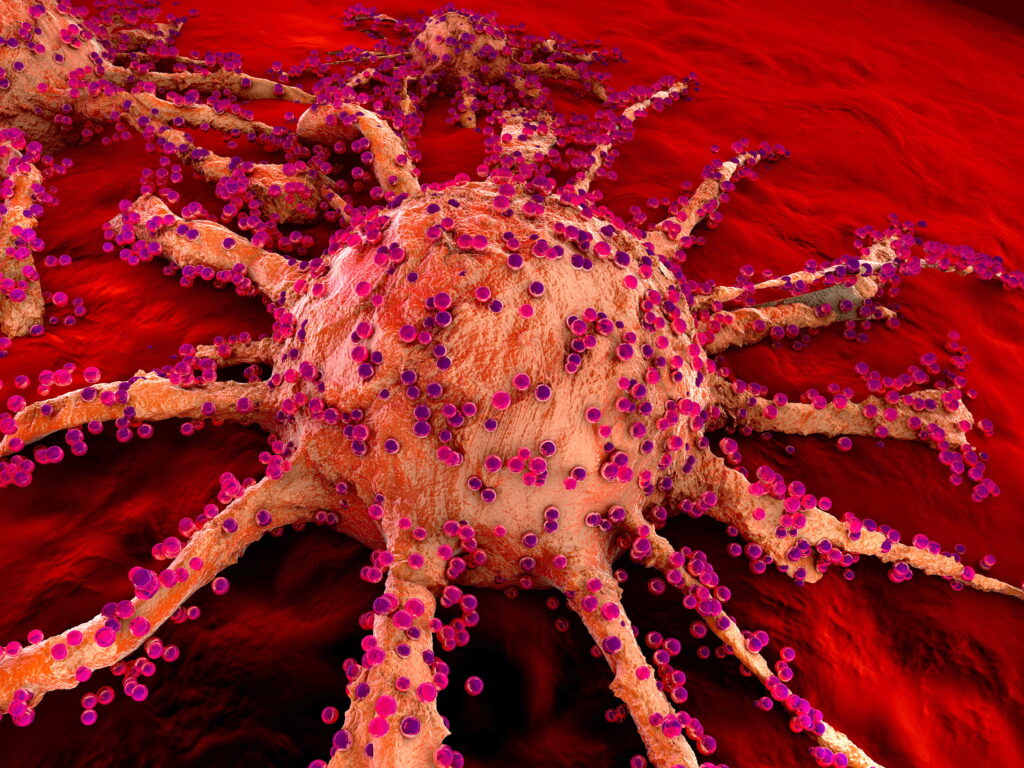
Throughout the human body, in virtually every tissue and organ, white blood cells called macrophages are waging a constant battle. These hardworking immune cells destroy germs, target cancer cells, and clear damaged cells from the body to promote tissue repair. Meanwhile, sly tumors exploit these capabilities, turning macrophages into Tumor-Associated Macrophages (TAMs), which promote cancer growth. The unique density of tumors also makes it difficult for external macrophages to fight back. But new research from the Korea Advanced Institute of Science and Technology (KAIST) has resulted in a therapeutic strategy that turns macrophages into active anticancer treatments. Read on for a summary of the research, which was led by Professor Ji-Ho Park from KAIST’s department of Bio and Brain Engineering.
How Immune Cells Target Stubborn Solid Tumors
Solid tumors, such as those seen in lung cancer, are tightly packed, virtually impenetrable masses. Even powerhouse macrophages struggle to breach these cellular fortresses or function within them. This structural issue weakens immune-based cancer treatments, even when those therapies are proven effective against other types of cancer.
To address this ongoing problem, the KAIST team focused on tumor-associated macrophages that naturally gather around tumors. Instead of fighting a losing battle, the team focused on ways to hone these macrophages’ natural behavior to eventually design a therapy that penetrates and works directly inside tumors.
A New Approach to CAR-Macrophage Therapy
The study focused on chimeric antigen receptor macrophages, or CAR-macrophages, which represent an exciting frontier in immunotherapy. Per the study, these macrophages represent “significant clinical success in hematologic malignancies,” but face “limitations in solid tumors.” In addition to the reasons outlined above, current CAR-macrophage therapies involve an expensive, difficult process: First, immune cells must be collected from a patient’s blood and grown in a lab. Then, the cells must be genetically modified before being returned to the body.
To fully harness the power of CAR-macrophages — macrophages with the potential to directly engulf cancer cells and activate nearby immune cells — the researchers needed to reprogram these immune cells without removing them from the body.
Hacking mRNA Coding for Immune Activity
The team carefully developed an in-situ CAR-macrophage therapy via codelivery of two crucial elements: mRNA to encode cancer-recognition information in the macrophages, and an immunostimulant compound to boost immune activity. To deliver the compounds, the researchers designed lipid nanoparticles (LNPs) that macrophages readily absorb. These LNPs were engineered specifically for tumor-associated macrophages, allowing the team to “achieve robust CAR expression directly within the tumor microenvironment.” In essence, the compounds created homegrown CAR-macrophages by “directly converting the body’s own macrophages into anticancer cell therapies inside the body.” A cancer-fighting macrophage army was born.
Promising Results
The therapeutic agent took effect instantly. When the treatment was injected into tumors, the macrophages already present in the body began producing cancer-recognizing proteins while also activating immune-signaling pathways. The macrophages transformed into what the team called “enhanced CAR-macrophages,” which exhibit much stronger cancer-killing prowess than standard macrophages. The treatment was effective in animal models of melanoma, contributing to significantly reduced tumor growth during the study.
_____
While further studies are necessary to demonstrate the efficacy of this treatment in human subjects, one thing is clear: These researchers have developed a new concept of immune cell therapy that works directly within the patient’s body, reducing the need for costly, invasive interventions.
QPS is a global, full-service, GLP/GCP-compliant contract research organization (CRO) delivering the highest grade of discovery, bioanalysis, preclinical and clinical drug development services. Since 1995, QPS has grown from a small bioanalysis shop into a full-service CRO with 1,200+ employees in the US, Europe, Asia and India. Today, QPS offers expanded pharmaceutical contract R&D services with special expertise in pharmacology, DMPK, toxicology, bioanalysis, translational medicine, PBMC processing, central safety labs, clinical trials, and clinical research services. An award-winning leader focused on bioanalysis and clinical trials, QPS is known for proven quality standards, technical expertise, a flexible approach to research, client satisfaction, turnkey laboratories, Phase I/II clinical units, and multi-site clinical research services. Through continual enhancements in capacities and resources, QPS stands tall in its commitment to delivering superior quality, skilled performance, and trusted service to its valued customers. For more information, visit www.qps.com or email info@qps.com.