


Plan the evidence. Support the label.
Support today’s approval and tomorrow’s new indications with a custom-built evidence generation strategy from QPS
Defining a Clear Process
A drug label is built on evidence that supports specific claims about a product’s use, benefits, and risks. Planning those claims early can help you identify the studies and data needed for an initial application and prepare for questions that may arise during regulatory review.
QPS can help map your intended label to a practical evidence strategy across nonclinical and clinical development. The plan can account for your product, target population, development stage, and future indication goals.
- Define the intended use: Indication, population, dose, and route
- Build supporting evidence: Nonclinical and clinical development
- Submit for initial labeling: Evidence-led regulatory review
- Plan for what comes next: Post-approval studies and new indications
Starting with the proposed use gives each study a purpose. It also helps your team see where evidence is available, where gaps remain, and which questions may need to be addressed before submission.
Connect Every Proposed Label Statement to Evidence
A clear development plan begins with the product’s intended use. Clearly define the indication, patient population, dose, route of administration, and expected benefit. Then build a roadmap that connects each proposed label statement to the nonclinical and clinical evidence needed to support it.
A label claim needs relevant evidence behind it. For each proposed statement, consider what data would support it, whether the available evidence addresses the intended population and use, and what additional work may be needed.
This early review can help sponsors set priorities, coordinate study planning, and prepare a submission strategy that reflects both the initial indication and possible future uses.
Build the Evidence. Inform the Next Decision.
The development pathway below shows how evidence can build over time. The studies required will depend on the product, indication, existing data, and regulatory strategy; the key is to connect each stage to the questions your team needs to answer.
Nonclinical Foundation
KEY DECISION: Is human testing justified?
Clinical Readiness
KEY DECISION: Are the product formulation and dosage ready for clinical trials?
Phase I and II
KEY DECISION: Does the evidence support moving the product and selected dosage into Phase III?
Phase III
KEY DECISION: Does the evidence support the proposed use?
Submission and Initial Labeling
OUTCOME: Regulatory review determines approval and labeling.
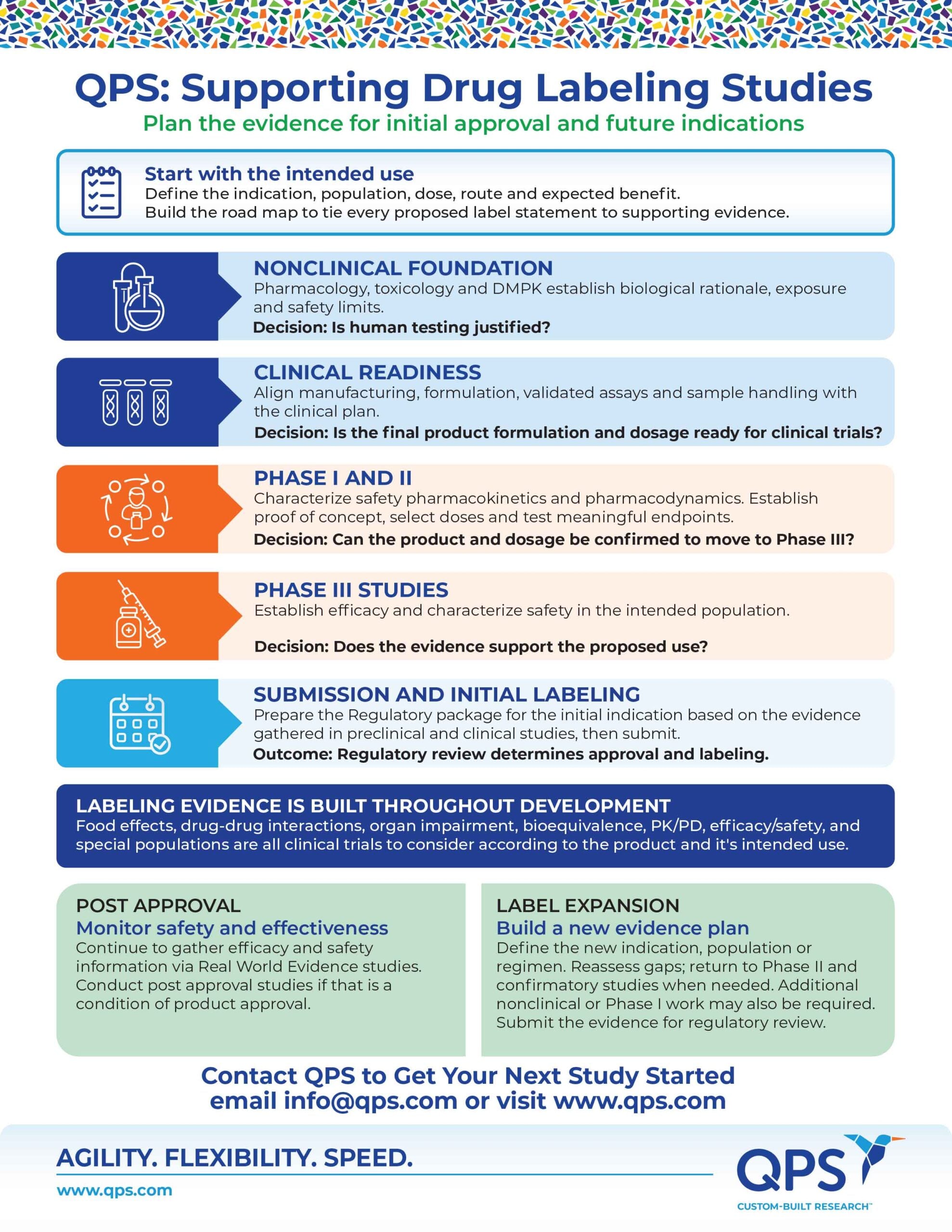
The clinical evidence plan may include studies addressing:
The right studies depend on the product, proposed use, available data, and regulatory strategy. QPS can help sponsors identify evidence gaps and plan the studies needed to answer key questions about how the product is used, its benefits, and its risks.
- Food Effects
- Organ Impairment
- Pharmacokinectics
- Efficacy and Safety
- Drug-drug Interactions
- Bioequivalence
- Pharmacodynamics
- Special Populations
Keep building the evidence for what comes next
Approval establishes the product’s initial use. Ongoing evidence can help you evaluate safety and effectiveness, meet post-approval requirements, and assess opportunities to serve additional patient populations.
Post-Approval
Monitor safety and effectiveness
Continue to assess safety and effectiveness in the approved population using appropriate post-approval studies and real-world evidence. QPS can help plan and conduct studies required by regulators or designed to address questions that emerge after launch, giving your team evidence they need to support ongoing product labeling decisions.
Label Expansion
Build a new evidence plan
A new population, condition, dose, or regimen may require additional evidence. QPS can help identify the remaining questions, define a study strategy, and conduct the nonclinical and clinical work needed to evaluate a proposed expansion and prepare supporting data for regulatory review. The new study strategy could include additional nonclinical or Phase I work, or a return to Phase II, depending on the revised labeling objectives.
Links to Relevant Documents
- Build a Labeling Evidence Strategy for Today's Approval and Tomorrow's Indications
- Rare Disease Clinical Trials
- Cardiometabolic Clinical Trials
- Oncology Clinical Trials
- Central Safety Labs – 2 page flyer
- PBMC Capabilities - 2 page Flyer
- Obesity Clinical Trials
- Clinical Trials in Special Populations
- Phase II-IV Clinical Overview
- Early Phase Clinical Overview

Contact Us
Would you like to learn more about other QPS capabilities?
Visit: https://www.qps.com/
Set Up a Meeting: https://www.qps.com/contact
Email: info@qps.com